Showing posts with label positive environment. Show all posts

Monday, January 22, 2018

Violent Children


This is a picture of my brother Felix with one of his favorite toys.  In those days, it was common for little boys to play with guns.  They pretended to be Cowboys and Indians or Cops and Robbers.  One summer, the boys in my neighborhood spent several weeks playing out the Civil War with both Union and Confederate armies.  As the Boomer generation, we grew up on stories of WWII.   Boys played with plastic soldiers and drew pictures of planes dropping bombs.  But there were no news stories about real life gun violence.   

Times have changed dramatically.  I'm not even sure if toy guns are sold anymore, except for water pistols.  The type of gun play that exists today is more likely to be paint ball, laser tag, or video and arcade games.  Yet news stories overflow with horrible mass murders, often committed by young people who have access to real guns.  Gun violence in our society is an epidemic.

Adolescent and adult behaviors have their roots in early childhood.  When children are very young, their bodies and brains are growing more rapidly than they ever will again. This is a critical time of life to acquire moral values and learn social behaviors.  Any aggressive behaviors in young children must be firmly addressed.  "Boys will be boys", expressed as rough and tumble play, is normal.  ( See my post on boys:  BOY POWER!)  Aggression is different.  Aggression is an intentional attempt to hurt someone, and cannot be tolerated.

Violent children are the most challenging to teach and to raise.  Most aggressive behaviors in young children are normal and can be managed relatively easily with positive discipline . (More in my post:  Discipline:  Key to Maturity)  Other times, aggressive behavior is a symptom of an underlying developmental issue, such as a learning disability, ADHD,  problems with sensory integration, an emotional disorder, or a medical condition.  Sometimes we find the roots of aggression in a child's environment.  Children suffering from abuse or neglect, children who witness violence at home, children caught in the middle of a highly contentious divorce, often turn to violent behaviors as an outlet for their pain.  And then there are a few children, very few, for whom we cannot find a source of their aggression. 

The examples above point to the dominance of nature, the qualities we are born with, and nurture, the effects of our environment, in determining our behaviors.  The truth is that both play an equally powerful role in deciding who a child will grow up to be.  When we observe aggressive behaviors in a child, we first look for a cause.  We take note of when and how the aggression takes place, seeking clues to both his nature and his environment. Is he bored, frustrated, confused, hurt, anxious....?  How can we modify his environment to help? A three year old was biting his classmates. We kept a log of his behavior and noticed that he bit different children during different activities.  The one constant was the timing; he usually bit about an hour before lunch and again just before dismissal.  We began giving him pretzel rods to chew on and the biting subsided. 

It is not easy to identify the causes of a child's aggression, and even harder to figure out the best way to help.  And what about those children for whom we cannot find a reason  for their behavior?  I've only met one, maybe two, in my career.  They scared me.  These are children who hurt others without provocation and without remorse.  They seem to like seeing others in pain.  They only care about their own desires.  They have a strong need to control their environment.  I just read a book and a magazine article that helped me understand these children better.  The book is Savage Spawn, by Jonathan Kellerman, a clinical professor of pediatrics and psychology, better known for his murder mystery novels.  The article appeared in the January issue of National Geographic, and is titled "The Science of Good and Evil".  I learned that empathy, the ability to experience how another person is feeling, can be measured in the brain by the size of the amygdala, and that psychopaths actually have smaller amygdalas than the rest of us. Fascinating.  That means that some people are genetically predisposed to be colder and more violent than others.

 Differences in a child's brain do not sentence him to a life of psychopathy or anti-social behavior.  All young children are ready and able to learn.  Their brains are still malleable.  Directly teaching appropriate behaviors helps every child learn social responsibility. Those  with a predisposition to violence can be trained in a structured environment that targets specific goals for behavior.  Positive reinforcement works by granting and removing privileges based on reaching these goals. This is a daunting task for teachers and parents who need to remain patient and positive for years.    

There are many curricular activities that teachers can bring into an early childhood classroom to promote compassion and cooperation.  Children can learn at an early age that it's cool to be kind.  They can be taught to identify their own emotions, as well as those of others, and to respond appropriately to those emotions.  At home and at school, adults can highlight the value of giving and doing for others.  We all know that children are our future.  With hard work and cooperation between teachers and parents, we can help make that future a bright one.
I


Wednesday, January 17, 2018

Positive Reinforcement


A couple of weeks ago, my grandchildren and I visited the Wildlife Zoo in Phoenix, Arizona.  We attended a sea lion show , but there was no performance. The sea lions were fairly new to the zoo and were still in training.  One of the zoo keepers explained the training process, while another demonstrated with a sea lion.  It was actually a lesson in positive reinforcement.  If the trainer wanted the sea lion to touch a pole, she would wait until it came close to the pole, then feed it a little fish.  Next time, the animal would get the fish as it reached up for the pole.  This would continue, with the pole being raised and the animal reaching higher until it learned to jump and touch the pole with its nose.  Interestingly, we saw another animal show in which a porcupine, a muskrat, and a parrot also learned to do tricks by repeating behaviors that brought them treats. 

Positive reinforcement is a method of teaching behaviors and skills by rewarding the student for closer and closer approximations to the desired goal.  It is standard practice in early childhood classrooms.  A reward is as simple as a smile, a hand on a shoulder, a hug, a few encouraging words, even saying the child's name in a delighted tone of voice.  So let's say we want a child to clean up his toys.  As he begins to pick up a toy, we immediately acknowledge his effort, "You're starting to clean up the blocks, good work!".  This simple praise generally serves to reinforce the behavior.  The child will continue the behavior and look forward to more praise.

To be most effective, positive reinforcement should be immediate. We must be watchful for any attempts made toward the target behavior, and immediately give feedback. The objective is to catch the child doing the right thing.  A common example in early childhood education is getting the children to settle down for circle time. All the teacher has to say is "I like the way Gabriel is sitting", and the other children will flock to sit nicely and hear their names too.  Amazingly, the effects of positive reinforcement are physically visible, not only in the behavior, but in the child's body language.  She appears to grow before our eyes, standng taller, filling up with a good sense of self.

 Positive reinforcement is used to praise effort.  It specifically addresses the approximation of a desired behavior.  This can be particularly helpful for children who are timid or find something distasteful.  Think of a picky eater.  If he takes a small bite of a new food we can say, "I know it's hard for you to taste new things, but you did it anyway.  I'm proud of you.".  Of course, this would be most powerful if he actually likes the new food, but again, we are praising the effort so that he will be more willing to try again next time.  Positive reinforcement is also important in teaching skills; "You're working hard to practice writing "S".  It's getting better and better."  In this last example, it might help to give a suggestion, such as "Try to reach the hat line next time." 

Positive reinforcement is a great motivator for older children and adults too  Everyone wants a pat on the back for the work that we do, but few of us actually get one.  Feeling noticed and appreciated keeps us motivated to stay the course and to work even harder. Positive feedback also clarifies expectations.  As an early childhood director, I looked for opportunities to compliment my staff, whether on a creative bulletin board, new lesson ideas, or the way they spoke with a student.  I understood that this type of feedback would reveal what I valued as quality work, and would motivate the teachers to keep it up.  (Truly, they made my job easy.  I worked with some amazing teachers.)   As an educator,  my greatest rewards were often the notes of thanks from parents.  These notes are treasured by teachers, who give so much of themselves to their students everyday, and are rarely recognized for their commitment.  An appreciated teacher is happier to do her job, and a happy teacher brings about optimal learning for her students. 

In my post "Hello Sunshine" I talked about the uplifting effects that positive people have on us.  In offering positive reinforcement, we can build on our children's strengths.  We can create a pleasant environment for work and play.  We can celebrate together all the little steps that lead to big learning and growth.

Wednesday, January 10, 2018

Hello Sunshine


Before taking my first job as Early Childhood Center Director, I underwent several interviews.  One school leader, whom I deeply respected, asked a question that threw me for a loop.  He said, "How do you say good morning to children?".  Huh?  How many ways are there to say "good morning"?  What did he really want to know?  

To prepare for this new position, I spent a day observing the center in action.  I was present when the children began arriving, and suddenly understood the meaning of that nebulous question.  Two boys walked through the door chatting, laughing, and gently pushing each other.  A teacher reprimanded them to stop that behavior and take their places on the floor, where they waited for their teachers to bring them to their classrooms. Ouch.  No one said "good morning" to those boys.  Their introduction to the new school day was a negative encounter with an impatient teacher.  They had to wait as a group, with nothing to do, before they could even enter their classrooms.  My heart sank.  

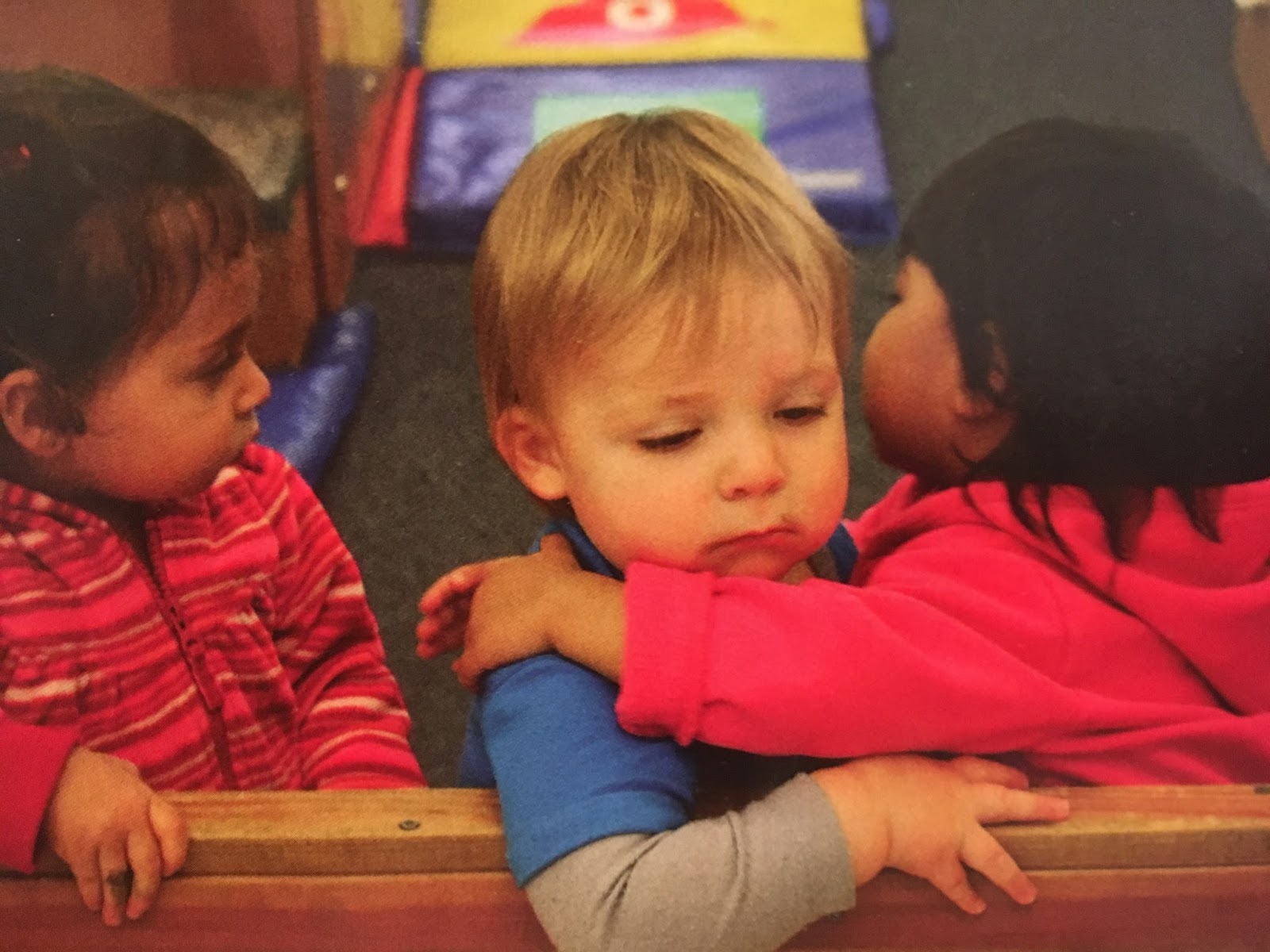
The way we greet children matters a lot and sets the tone for the rest of the day.  Every child deserves a warm, individual greeting at the classroom door.  Eye contact, a big smile and a brief, personal comment make our students feel welcome and special.  "Hi, Marcy, that's such a pretty bow in your hair.  Is it new?".  Marcy will feel noticed and appreciated.  Being the teacher's center of attention for a minute builds her confidence and energizes her to tackle the day's activities.  The teacher has established a personal connection that will motivate that student to participate and follow class rules.  That's a lot of value for a couple of minutes worth of pleasantries.

The same is true at home.  Whether welcoming our children at our door or at car pool, a smile and a hug show them how much they mean to us. That moment of focused attention is powerful, non-verbal language that says, "I love you, I missed you, you're important to me." .  Do your eyes light up when your child returns to you?  That's emotional gold to little egos.

Treating other people with respect and dignity is a basic human obligation.  Greeting each person we meet with a friendly smile is an expression of this obligation.  There is a famous verse in Ethics of Our Fathers, a Jewish text on ethical behavior and interpersonal relationships, that teaches: "Receive every person with a cheerful face".  A smile is an uplifting action that can profoundly impact another person.  I remember my surprise when I read something that a boy I hardly new wrote in my high school year book, "The smiles you gave me when you walked past me in the hall I won't forget".  I had no idea that I had made such an impression on him.  I learned that a smile is a gift.  It is an expression of love from one human being to another.  It says, "I see you. I recognize you.  We're connected by our humanity.".

Another benefit of greeting people warmly is that it helps us to accomplish our goals.  We all enjoy the company of positive, upbeat people, and are more willing to hear them out, more comfortable to work with them. Positive feelings give us energy, motivation, and confidence.  Smiles are contagious.  Even on the phone, people can relate to the tone of our voice.  When I recorded a voice greeting for my phone at the early childhood center, I always smiled  while I spoke.  I believed that smile could be heard.  It communicated non-verbally that my school was a warm, positive, welcoming place.

Quick smiles don't come naturally to all of us, but they are easy to learn.  If we consciously put a smile on our face each time we make eye contact, even with a stranger, it will eventually become a habit. Motor memory.  And a default smile will in turn help us and those around us feel more positively.  Spread some sunshine in our world.  Smile!


Monday, October 2, 2017

C'mon People Now


Say what you will about the Boomer generation, we had the best music.  The title of this post is from a song by Buffalo Springfield that was playing through my head as I wrote.  Check it out, it's worth it.

Teaching social skills is a core component of early childhood education.  Polite behavior is not innate, it is a learned skill.  When children misbehave, we assume that they have not yet learned socially acceptable means of solving their problems or meeting their needs.  A two year old who wants a toy that his playmate has is likely to grab it directly or hit his playmate til he gets it.  He's not a bully; certainly not a bad boy.  He simply doesn't know a better way of getting what he wants.  It's the job of the adults in his life to teach him.  We use words to identify his problem, then feed him words that can help him get what he wants peacefully.  "You want to play with the helicopter.  You can't hit, but you can use your words.  You can say, 'Can I please play with the helicopter?'.  Many children will hand over the toy after this exchange, and we simultaneously praise them and model a "thank you".   If a child isn't ready to hand over the toy, we can model negotiating:  "Okay, when you are done, your friend will have the next turn".

Words are powerful.  The words that we choose can affect the world for good or for bad.  Think about our reaction to a whiny, "I want apple juice", compared to a calm, "Can I please have some apple juice?".  Kind, respectful words effect kind, respectful responses.  Part of our job as parents and teachers is to guide our children to use their words in positive ways.  We keep in mind that they are learning.  If they mess up, it's because they don't  know better yet.

 Adults won't typically hit someone with whom they have an issue, but they might use violent language.  I sometimes wonder if these adults simply got stuck at an early developmental stage. Maybe no one took the time to teach them the power of words.  Words can bring us closer to our goals or put up barriers.  They can make our environment pleasant or uncomfortable.  As children we used to chant, "Sticks and stones may break my bones, but names will never hurt me."  We were so wrong!  Words can hurt deeply. Victims of emotional or verbal abuse sometimes think, "Just hit me and get it over with".  The pain of a slap goes away faster than the emotional scars of hateful words. 

I believe that training ourselves to speak only positively, particularly about other people, will make us happy.  We look for the good in everyone we meet. If someone speaks badly about our friend, we can speak up and point out her good qualities.  Making a practice of defending people will discourage others from gossipping to us.  We'll develop a more optimistic outlook.  On the other hand, remaining silent hurts everyone; just like standing by when someone is bullied.

There is so much hateful, divisive language on the news and social media today.  Fighting hate with hate is unproductive at best and dangerous at worst.  Negatively name-calling those with different opinions spurs hate and division.  It's emotional bullying and reflects an incapacity to express oneself properly.  People who resort to name-calling are probably developmentally stuck.  It's hard to tolerate that ignorance in adults because we assume they should know better.   But they might not.  They may have skipped some important lessons in early childhood. 

 People have good intentions. They mean well.  Very few really want to cause harm.  They may struggle to express themselves in a better way.  That should motivate us all the more to speak from a place of kindness and respect.   Again, these thoughts are expressed so well in music.  Listen to this beautiful song by Dave Mason, "We Just Disagree" and think about it the next time someone says something stupid or mean.

https://www.youtube.com/watch?v=b2ff8qXa248