This is a picture of my brother Felix with one of his favorite toys. In those days, it was common for little boys to play with guns. They pretended to be Cowboys and Indians or Cops and Robbers. One summer, the boys in my neighborhood spent several weeks playing out the Civil War with both Union and Confederate armies. As the Boomer generation, we grew up on stories of WWII. Boys played with plastic soldiers and drew pictures of planes dropping bombs. But there were no news stories about real life gun violence.
Times have changed dramatically. I'm not even sure if toy guns are sold anymore, except for water pistols. The type of gun play that exists today is more likely to be paint ball, laser tag, or video and arcade games. Yet news stories overflow with horrible mass murders, often committed by young people who have access to real guns. Gun violence in our society is an epidemic.
Adolescent and adult behaviors have their roots in early childhood. When children are very young, their bodies and brains are growing more rapidly than they ever will again. This is a critical time of life to acquire moral values and learn social behaviors. Any aggressive behaviors in young children must be firmly addressed. "Boys will be boys", expressed as rough and tumble play, is normal. ( See my post on boys: BOY POWER!) Aggression is different. Aggression is an intentional attempt to hurt someone, and cannot be tolerated.
Violent children are the most challenging to teach and to raise. Most aggressive behaviors in young children are normal and can be managed relatively easily with positive discipline . (More in my post: Discipline: Key to Maturity) Other times, aggressive behavior is a symptom of an underlying developmental issue, such as a learning disability, ADHD, problems with sensory integration, an emotional disorder, or a medical condition. Sometimes we find the roots of aggression in a child's environment. Children suffering from abuse or neglect, children who witness violence at home, children caught in the middle of a highly contentious divorce, often turn to violent behaviors as an outlet for their pain. And then there are a few children, very few, for whom we cannot find a source of their aggression.
The examples above point to the dominance of nature, the qualities we are born with, and nurture, the effects of our environment, in determining our behaviors. The truth is that both play an equally powerful role in deciding who a child will grow up to be. When we observe aggressive behaviors in a child, we first look for a cause. We take note of when and how the aggression takes place, seeking clues to both his nature and his environment. Is he bored, frustrated, confused, hurt, anxious....? How can we modify his environment to help? A three year old was biting his classmates. We kept a log of his behavior and noticed that he bit different children during different activities. The one constant was the timing; he usually bit about an hour before lunch and again just before dismissal. We began giving him pretzel rods to chew on and the biting subsided.
It is not easy to identify the causes of a child's aggression, and even harder to figure out the best way to help. And what about those children for whom we cannot find a reason for their behavior? I've only met one, maybe two, in my career. They scared me. These are children who hurt others without provocation and without remorse. They seem to like seeing others in pain. They only care about their own desires. They have a strong need to control their environment. I just read a book and a magazine article that helped me understand these children better. The book is Savage Spawn, by Jonathan Kellerman, a clinical professor of pediatrics and psychology, better known for his murder mystery novels. The article appeared in the January issue of National Geographic, and is titled "The Science of Good and Evil". I learned that empathy, the ability to experience how another person is feeling, can be measured in the brain by the size of the amygdala, and that psychopaths actually have smaller amygdalas than the rest of us. Fascinating. That means that some people are genetically predisposed to be colder and more violent than others.
Differences in a child's brain do not sentence him to a life of psychopathy or anti-social behavior. All young children are ready and able to learn. Their brains are still malleable. Directly teaching appropriate behaviors helps every child learn social responsibility. Those with a predisposition to violence can be trained in a structured environment that targets specific goals for behavior. Positive reinforcement works by granting and removing privileges based on reaching these goals. This is a daunting task for teachers and parents who need to remain patient and positive for years.
There are many curricular activities that teachers can bring into an early childhood classroom to promote compassion and cooperation. Children can learn at an early age that it's cool to be kind. They can be taught to identify their own emotions, as well as those of others, and to respond appropriately to those emotions. At home and at school, adults can highlight the value of giving and doing for others. We all know that children are our future. With hard work and cooperation between teachers and parents, we can help make that future a bright one.
A reader asked for my thoughts on bullying. I've avoided the topic for awhile because I don't think I know that much about it. Nevertheless, bullying is so common, so harmful, and so relevant to our times, that I find I'm thinking about it a lot.
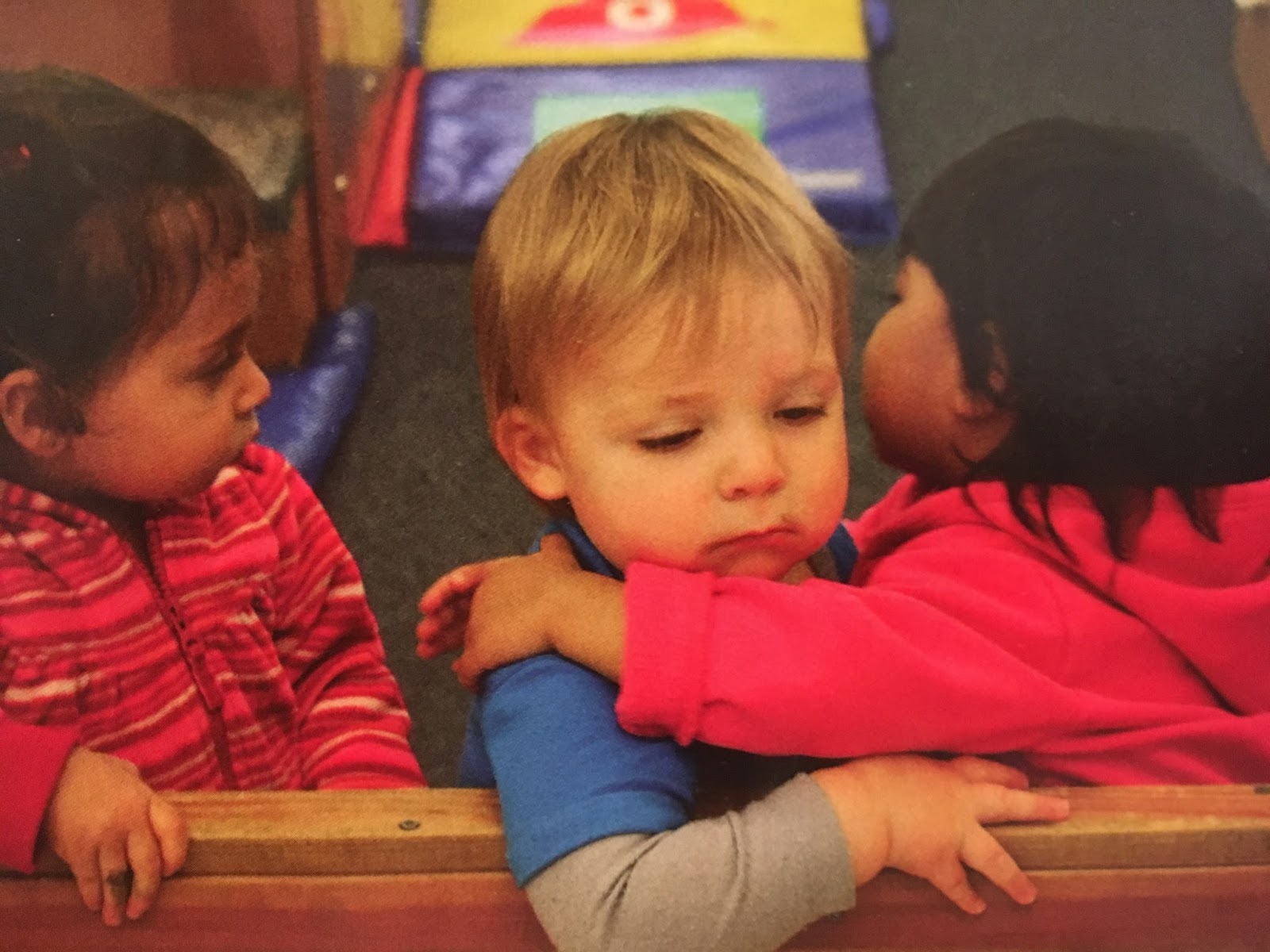
Most of my experience has been in early childhood education, where we see the seeds of bullying, but not real bullying per se. It begins when children try to attach dire consequences to not getting what they want: "If you don't let me play with your new toy, you can't come to my party", or "I won't be your friend". They've learned that undesirable behaviors have consequences, and they try to intimidate their friend to satisfy their wants. These children can be taught to use better language. The adults in their lives should point out that words can be as hurtful as as hitting. Telling someone they can't come to your party will hurt their feelings, and not be true anyway. It's better to be direct: "That's a great toy. Can I have a turn?". If the child is denied a turn, we can help her find something else to play with, talk about her favorite playthings, involve her in another activity. We can also ask the child with the special toy to grant a few minutes to his friend, or think about a way that they can play with it together. Without adult guidance, can this turn into bullying as they get older?
Another germ of bullying in early childhood can be seen when a child is excluded from play. "You can't play with us". This is very difficult for adults to witness and so painful to the child. We expect everyone to be friends and get along. Realistically though, this is not so easy. Even as adults, we click better with some people than others, we prefer to spend time with some friends over others. This happens with children, too. However, telling someone they can't play is rude and hurtful. We made a rule in my early childhood programs that "You can't say you can't play". In school, learning to get along with others, maybe especially with those who are different, is a core part of the curriculum.
Of course no one would ever ask, but any four year old could name the "weird" kid in his class. Children who present differently than their peers can make those around them uncomfortable. It's hard to relate and find common ground. This is where the teacher must step in and seek ways to "normalize" the child; show respect and use positive language for his ideas and his class work; find ways to include him in play with others, either through a board game, which forces turn-taking, or simply sharing toys at the play-dough or sand tables. Sitting with the child at these times to facilitate conversations will help him integrate with his classmates. Again, if there is no adult guidance in this scenario, can this become bullying?
Bullying among older children is harder to pinpoint because it does not take place in front of adults. I remember a girl in my elementary school that was called the "Cootie Queen". Boys especially would laugh and make fun of her regularly. I'm ashamed to say, I did nothing, and even understood why they called her that. She was always dirty, with greasy hair and raggedy clothes. She was very quiet and withdrawn. In this case, the bullies were saying aloud what others were thinking. And in this case, I think the adults could have done more to prevent the taunts. A caring teacher could have talked to the girl about hygiene and called the parents. One of the hardest calls I ever made as an early childhood director was to the parents of a child who smelled terribly. The parents determined that she wasn't wiping herself properly after toileting. I don't know, but I like to think that we saved her from being teased.
There are many school programs to combat bullying. In general, I think the best way to fight it is to make it cool to be kind. Adults should refrain from gossip. We need to watch our words when talking about people or institutions, like the school. We should not allow our children to talk badly about anyone. Talking badly about someone can turn to talking badly to someone. Children should also either avoid, or at least be taught about, TV characters who are portrayed as 'stupid', 'nerdy', less than others. It is so important to find the good in everyone and speak kindly.
Victims of bullying need support. Teachers and parents should encourage them to report any incident that makes them uncomfortable. Reporting incidents of bullying is not tattling. Parents can take note of any social skills that their child may need to strengthen. We can teach her to make eye contact, to use good posture, to modulate her voice so it's not too loud and not too soft. Encourage children to pursue their special interests in a club or summer camp where they might meet other children who share those interests. We can also encourage play dates, and participation in social events at school or in the neighborhood. A child who can count on trusted adults, who feels good about herself, and who has one or two close friends should be less likely to feel like a victim.
The effects of bullying can be fatal, as we've seen too many times. Teens especially are so sensitive to what others say and think about them. Maybe that's one reason they're addicted to social media. Technology can be our worst enemy in fighting bullying. We all must recognize the power of words, and teach our kids to never put anything in writing that they wouldn't say to someone's face. Words hurt, maybe more so in writing, where the tone is left to our imagination.
I believe we were all made in the image of G-d. Every life is sacred. If we try hard to speak and act as if we really believe that, maybe our children will learn kindness and stop bullying. I hope so.

Say what you will about the Boomer generation, we had the best music. The title of this post is from a song by Buffalo Springfield that was playing through my head as I wrote. Check it out, it's worth it.
Teaching social skills is a core component of early childhood education. Polite behavior is not innate, it is a learned skill. When children misbehave, we assume that they have not yet learned socially acceptable means of solving their problems or meeting their needs. A two year old who wants a toy that his playmate has is likely to grab it directly or hit his playmate til he gets it. He's not a bully; certainly not a bad boy. He simply doesn't know a better way of getting what he wants. It's the job of the adults in his life to teach him. We use words to identify his problem, then feed him words that can help him get what he wants peacefully. "You want to play with the helicopter. You can't hit, but you can use your words. You can say, 'Can I please play with the helicopter?'. Many children will hand over the toy after this exchange, and we simultaneously praise them and model a "thank you". If a child isn't ready to hand over the toy, we can model negotiating: "Okay, when you are done, your friend will have the next turn".
Words are powerful. The words that we choose can affect the world for good or for bad. Think about our reaction to a whiny, "I want apple juice", compared to a calm, "Can I please have some apple juice?". Kind, respectful words effect kind, respectful responses. Part of our job as parents and teachers is to guide our children to use their words in positive ways. We keep in mind that they are learning. If they mess up, it's because they don't know better yet.
Adults won't typically hit someone with whom they have an issue, but they might use violent language. I sometimes wonder if these adults simply got stuck at an early developmental stage. Maybe no one took the time to teach them the power of words. Words can bring us closer to our goals or put up barriers. They can make our environment pleasant or uncomfortable. As children we used to chant, "Sticks and stones may break my bones, but names will never hurt me." We were so wrong! Words can hurt deeply. Victims of emotional or verbal abuse sometimes think, "Just hit me and get it over with". The pain of a slap goes away faster than the emotional scars of hateful words.
I believe that training ourselves to speak only positively, particularly about other people, will make us happy. We look for the good in everyone we meet. If someone speaks badly about our friend, we can speak up and point out her good qualities. Making a practice of defending people will discourage others from gossipping to us. We'll develop a more optimistic outlook. On the other hand, remaining silent hurts everyone; just like standing by when someone is bullied.
There is so much hateful, divisive language on the news and social media today. Fighting hate with hate is unproductive at best and dangerous at worst. Negatively name-calling those with different opinions spurs hate and division. It's emotional bullying and reflects an incapacity to express oneself properly. People who resort to name-calling are probably developmentally stuck. It's hard to tolerate that ignorance in adults because we assume they should know better. But they might not. They may have skipped some important lessons in early childhood.
People have good intentions. They mean well. Very few really want to cause harm. They may struggle to express themselves in a better way. That should motivate us all the more to speak from a place of kindness and respect. Again, these thoughts are expressed so well in music. Listen to this beautiful song by Dave Mason, "We Just Disagree" and think about it the next time someone says something stupid or mean.
https://www.youtube.com/watch?v=b2ff8qXa248