Showing posts with label play. Show all posts

Tuesday, December 5, 2017

Toys: My Holiday Picks


I love shopping for toys, and with 17 grandchildren I get plenty of opportunities to do so.  If play is the work of childhood, then toys are the tools.  Carefully chosen toys give children the means to explore their world and to acquire a plethora of important skills and knowledge.  Unlike traditional tools however, the best toys are open-ended, with a generalized purpose.  In carpentry for example, certain jobs require very specific tools. In play, good toys should be used in multiple ways, only limited by a child's imagination.  Think of a set of unit blocks, which are a staple in early childhood classrooms.  Children can build towers, farms, skyscrapers, zoos, neighborhoods, roads, or any structure that they might dream up.  Blocks are sometimes used to take the place of people or planes or trees. (This sort of representational play is actually quite sophisticated, and is a prerequisite to reading and creativity.)   Some other basic super toys for children of all ages include play-doh, art supplies (crayons, paints, markers...), balls, vehicles, dolls, books, puzzles, and riding toys.  


  Toys are the best gifts to give to children because they are appreciated so much more than anything practical.  And isn't the point of gift-giving to bring joy to the recipient?  When choosing a gift,  the first consideration should be the child's interests and current developmental levels.  A good toy will bring her hours if not years of fun. My own grandchildren range in age from 7 months to 17 years, so I thought it might be helpful to share some of my gift ideas for different age groups.  If you know any of my grandchildren, please don't tell!


My youngest granddaughter is the fourth child in her family.  I'm getting her a soft doll and money for spring clothes.  Toy shopping for Infants can be difficult because they neither need nor appreciate toys.  They are just as happy to grab and mouth a paper cup as an expensive teething toy.  That being said, board books are good infant toys, as are play mats and bouncers.  As they pass their first birthday, they might enjoy walker toys (they hold on and toddle), an outdoor swing, banging toys like balls and hammers, nesting toys, soft blocks, or a toy piano.  A favorite toy I gave my one year olds was a rocking horse.


Twos are ready to manipulate their fine motor muscles.  They like farm houses with little animals, or garages with small cars and an elevator they can crank up and down.  Peg boards, large beads for lacing, Mr. Potato Head, shape sorters, all work their fine muscles and are great fun.  Twos also enjoy bath toys and riding toys that they move by pushing their feet. The best two year old toy I've given was probably a wagon.  Kids love to ride and pull their friends, and parents find them useful at parks and zoos.

Three year olds are busy acquiring language and beginning to play imaginatively.   They're steadier on their feet and ready for large muscle toys.  Previous gifts I've gotten for three year olds were hoppers (to sit on and bounce), trikes, scooters, dolls and accessories, floor puzzles, dress-ups, puppets, tool kits, and basketball hoops.  The most popular were probably the play kitchens I got for each family.  This year, I have three three-year old grandchildren:  two boys and a girl.  I got my granddaughter Spin Art.  I got both grandsons something called Tap and Tack.  It's a cork board that comes with various wooden shapes, each with a little hole, and child-safe nails and hammer.  They'll hammer the shapes onto the board and make up their own designs. 


Fours and fives will enjoy many of the same toys as threes.  As their skills are more advanced, they begin to play simple board games like Candy Land, Chutes and Ladders, or Connect Four.  They may advance from trikes to two-wheelers, from Duplos to Legos.  This year, four of my grandchildren are six years old:  two girls and two boys.  One girl is getting a play-school set.  It comes with a chalkboard, chalk, name plates, prizes... she picked it out of a catalog (lakeshorelearning.com).  I bought her cousin a set of tangrams.  It's a magnetic set, with shapes that can be arranged to look like animals.  One of my boys is getting a set of walkie-talkies, and the other is getting a build-your-own creature with remote control capabilities.  He  picked it from the same catalog.  


There are two eight year olds, one nine year old, one ten year old, and two eleven year olds in our family.   Only one of the eight year olds is a girl.  She chose the same school play set as her six year old cousin. Her eight year old cousin is getting a complete 2017 set of baseball cards.  The nine, ten, and one eleven year old are all getting  ATM style savings banks.  They love money and have collected empty bottles and set up lemonade stands to earn some, so I know this will be a hit.  The other eleven year old is getting Boggle, a word game he can play with his siblings.


We have three teenage grandchildren. They are impossible to shop for.  Even if I think of something they might like, teens in general are very picky.  So they are each getting money, and I know they will be thrilled.


As much as I love buying toys, there are times when the best present is a special one-on-one outing.  Giving individual attention to one child, maybe attending a game or show, is a priceless gift for both the recipient and the giver! 


 It's so much fun to give to our children, to make them happy.  I hope you enjoy shopping and are rewarded with lots of smiles and hugs and days filled with play.




Sunday, October 22, 2017

Outdoor Play


Want smart, healthy kids?  Send them out to play everyday.  Or take them.  Just make sure they get out of the house for part of the day. Outdoor play is absolutely essential for healthy physical and mental development. 

Right now, here in New York, it is October.  The weather is gorgeous, with clear, sunny days and stunning fall foliage.  Most of us try to get outside as much as possible.  But winter is coming, and spending time outdoors becomes more difficult.  The days become shorter and colder, with less time, and for many of us less incentive, to leave the warmth of our homes.  But even in winter, children need to spend time outside. There is simply no substitute for it. Hopefully, your children's teachers embrace this reality and make outdoor play a priority.  Unless it is snowing or raining, even a brief walk in very cold weather will benefit our children.

My first child was born in a freezing February.  She was three weeks early and severely jaundiced.  She spent the second week of her life in the neonatal intensive care unit, where she received two complete blood transfusions.  When she was released, the nurses admonished me to get her outside every day.  They said that many babies returned to the hospital because they were kept in stuffy, heated rooms and not given enough fresh air to breathe.  They told me to bundle her up and take her out for at least 15 minutes a day.  I took their words to heart.

The cold air does open our respiratory systems and counter the effects of dry, heated rooms.  We get doses of vitamin D from sunshine that are difficult to get elsewhere.  Outside, we exercise our eye muscles with increased peripheral vision, distance sighting, and depth perception.  We are also able to exercise our large muscles outside on a variety of terrains and levels.  Outdoors we can run, jump, climb, roll, dig, throw, balance.  Children challenge their bodies to run faster, climb higher, building strength, agility, and confidence. Outdoor play get our hearts pumping to benefit circulation and build a healthy appetite.  And outdoors, children can yell and holler, releasing tension and expressing pure joy in a way that is not always appropriate indoors.  


The natural world is a science laboratory.  Children learn about cause and effect while they watch the wind blow through the trees, or see how puddles develop after rain.  In winter, those puddles turn to ice; in summer, they evaporate.  We see shadows, caused by the sun, which change as the day goes on.  We notice so many varieties within each natural element:  clouds can be fluffy, thick, grey, or dark; trees can drop pine cones, acorns, chestnuts, or maple pods; bugs can fly, crawl, slither, or dig; rocks can be huge, tiny, rough, smooth, etc., etc.  Every experience with the natural world builds concepts and knowledge.

Being outside often has a calming effect on children.  The natural world abounds in treats for all of our senses.  Outdoors we are surrounded by fresh textures, colors, sounds, and smells to enjoy and spark our curiosity.  What child can resist jumping in a rain puddle or a pile of leaves?  Who hasn't stuck out her tongue to catch a raindrop or snowflake?  Who's been lucky enough to eat a berry right off a bush?  Yum.  Sensory experiences are very soothing. 


I believe that children who spend lots of time outdoors grow to be better people.    They develop a connection to the physical world that enables them to appreciate and respect our planet.  To love the world is to love life and all its creations.  In this way, outdoor play can also serve a child's spiritual development.

Open your child's potential for good health, intelligence, and a kind spirit.  Get him out of the house!!  


Sunday, August 20, 2017

Look Ma, No Hands!!: Sharing Ourselves with Our Children

Whenever I took my kids to a playground or park or even just sat outside while they played, they inevitably and constantly called, "Watch me!  Mom, watch me!!".  I would look once or twice and then get annoyed.  "Just play!  Why is it only fun if I watch?".

Well, because mostly it is.  Kids are often more engaged in play when adults join them.  I learned that when I was 19  and worked the summer as a Recreation Leader in a public park about a block from my home.  The city supplied me with crafts materials for the kids; lanyard, crepe paper, markers, etc.  But unless I joined them in crafting something, very few children were interested.  That went for games too.  They were much more likely to play kickball or duck-duck-goose if I played too.

As an early childhood educator, I learned to deeply appreciate this child-quality.  I found it to be an innate mechanism children employ to acquire skills and values.  Children, like everyone else, want to be noticed, to be heard.  They want to know that we value whatever it is that they may care about.  They will look to loving adults to confirm that "Yes, you're a good climber; yes, that bug is fascinating; yes, you can jump really high".  Our confirmation makes it true.

When we in turn share our passions and interests with children, and actually live the values we profess to care about, we can profoundly shape their understanding of the world and even help to build their character. We don't have to tell our children what's important to us.  They know since infancy what we value, by our actions, our tone of voice, our body language.  Long before they can speak, our babies are watching us carefully, and learning.  My grandfather, who smoked at least a pack a day until he died at age 80, used to say, "Do what I say, not what I do".  Sorry grandpa, that didn't work.  I smoked cigarettes for 13 years.  The opposite of that refrain is actually true:  children learn from what we do and who we are, not from what we say.  

A few months ago some of my high school students and I were discussing the qualities they felt made a good teacher.  The consensus was, 'someone who loves sharing his/her passion'.  Think about your favorite teacher(s).  I'll bet he/she was enthusiastic about the subject matter and cared a lot about the students with whom he/she shared it.

So, I make an effort to put down my book or crossword puzzle and play with my grandchildren.  And  when something cool snags my interest, I'll call them over and say "Hey, take a look at this!".

Sunday, August 6, 2017

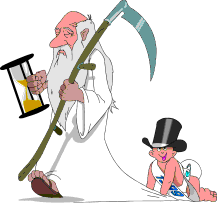
Time Flies: Staying Present


Today I was privileged to hear my oldest grandson Binyamin layn his Bar Mitzvah parsha from last summer. As it happens, my son Simmy had layned the same parsha for his Bar Mitzvah, 18 years ago.  Listening to Binyamin today, thinking about him and Simmy, made me think about the passage of time.

Adults often remark that time flies.  "It seems like yesterday"; "It's been how long? I can't believe it!".  This is especially true of teachers in June:  "This year went by so fast!".  Honestly, I don't feel that way at all.  I feel like I've been on this planet a long time.  I often wake up in the morning and think, "Really?  I get another day?".  But I do feel like large chunks of my life are missing, because I simply don't remember.  I remember incidents from my childhood, or from my children's childhoods, but much is lost to me.  I'm wondering if time just seems to pass quickly because many of our experiences get sucked into oblivion.

 I believe my faulty memory is due in large part to my failure to stay in the present moment.   John Lennon sings:  "Life is what happens to you while you're busy making other plans".   It is so difficult to quiet my scattered thoughts and just be fully present to where I am and what I'm doing at any given moment.  My yoga instructor calls that "monkey brain"; my mind jumping from one random thought to another, like a monkey from branch to branch. 

We've all been advised,  "Enjoy your children while they're young; they grow up before you know it."  But our monkey brain often robs us of that enjoyment because we're too busy thinking of our endless to-do lists, or ruminating over some past hurt, or tensing up about some future event.  Or maybe we're checking emails, texts, posts; mindlessly jumping around our devices.

We can learn from children to live more in the present. Young children don't have an acute sense of time.  Days are measured by routines:  meal time, bath time, bed time.  So they are always in the present, always learning, reacting, and experiencing life in real time.  (The exception is when/if they're hooked up to screens, which rob them of real time.)  

Children spend their time playing.  Play is so important to them that most children are happy to play with whomever is available at the time.  They may fight over toys or their roles in play, but chances are they'll be best of friends again shortly. They don't waste time holding grudges.  Have you ever noticed how much quicker a young body heals from physical injuries than an older one?  The same is true of young egos.  Whatever is happening at the moment takes precedence over any insult, whether past or anticipated.  I read a study once that found that children laugh many, many more times a day than adults do.  No wonder.

At this stage of my life, it feels like my days are more precious.  I'm trying to tame the monkey, put away the phone when I'm with my loved ones, bring more play into my life and live every moment to its fullest.